By Team @ Ledgerly
What is budget planning? How to plan and forecast your money
What budget planning is, the parts of a plan that matter, how to forecast the next few months, and how to adjust when things change.
Updated October 18, 2026
budget planningpersonal budgetingexpense trackingbudget categoriesmoney management
You check your bank balance halfway through the month and feel a familiar jolt. The rent is paid, your salary has arrived, and yet the remaining money looks smaller than expected. You can remember a few grocery trips, a subscription renewal, and some card purchases, but not enough to explain where everything went.
That experience doesn't mean you're careless with money. It often means your budget is too static for the way your finances work. Income may arrive on different dates, expenses may appear unexpectedly, and money may move between cash, checking, savings, and credit accounts. Budget planning works best as a living measurement system, one that records what happened, compares it with what you expected, and helps you decide what to do next.
Table of Contents
- Why Budget Planning Feels Harder Than It Should
- What Budget Planning Actually Means
- The Core Components of a Budget Plan
- Setting Goals and Building Categories
- Budgeting When Income Is Irregular
- Monitoring Progress and Adjusting Your Plan
- Forecasting the next few months
- How Ledgerly Supports the Budget Planning Process
- Your First Steps to a Working Budget Plan
Why Budget Planning Feels Harder Than It Should
Traditional budgeting advice often begins with a neat assumption: one predictable paycheck arrives, the month starts, every expense fits a category, and the month ends with a clean review. Real life rarely follows that sequence. A freelancer may receive payments at uneven times, a household may share several accounts, and an annual bill can arrive long after the original budget was created.
The frustration gets worse when a person treats the budget as a test they can fail. A restaurant meal goes over the planned dining limit, a utility bill changes, or a card payment is forgotten. The person then abandons the whole plan because the numbers no longer match the original template.
A practical budget isn't a promise that nothing will change. It's a way to notice change early enough to respond.
The problem usually isn't a lack of discipline. It's a mismatch between a rigid monthly envelope and a financial life that moves continuously. A useful plan must answer more than “How much can I spend this month?” It should also help answer:
- What has already happened? Which transactions have reduced available money?
- What is still due? Which recurring or scheduled expenses are approaching?
- What can change? Which categories can absorb an adjustment without disrupting essentials?
- What happens across accounts? Is money being transferred, spent, or held elsewhere?
That shift in perspective matters. Budget planning isn't mainly about restricting every purchase. It gives you a clearer view of your current position, so decisions aren't based on a vague bank balance or a hopeful guess.
What Budget Planning Actually Means
Budget planning is the structured process of recording income and expenses, tracking how they change over time, and allocating available resources according to your priorities. It combines three actions:
- Record what comes in and what goes out.
- Track actual results against your expectations.
- Allocate money toward essentials, goals, and flexible spending.
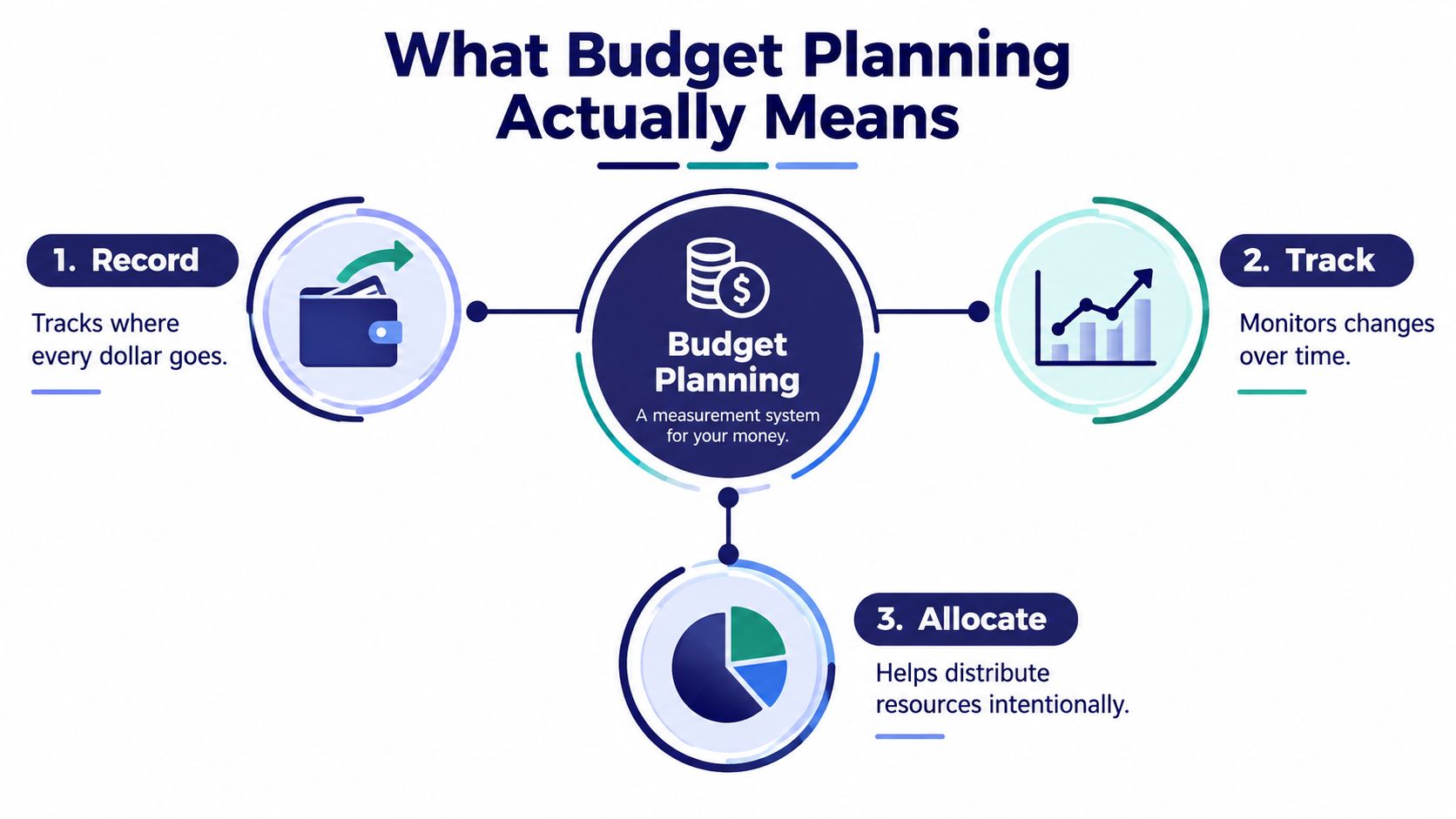
This definition is broader than “make a list of bills.” A list tells you what you expect to happen. A budget plan also checks what happened and uses that information to improve the next decision.
The household survey analogy
Public institutions use a similar measurement logic at a much larger scale. In the European Union, each member state conducts household budget surveys to measure spending on goods and services. Eurostat explains that these surveys help build the weightings used for consumer price indices and national accounts, linking household spending data with inflation measurement and wider economic statistics.
The same source reports that Spain's 2024 Household Budget Survey recorded average household expenditure of 34,044 euros, a 4.4% increase, while average spending per person reached 13,626 euros. It also found that the lowest-spending quintile devoted 60.2% of its budget to housing, utilities, food, and non-alcoholic beverages. Those figures illustrate why tracking matters: essential costs can absorb much of the money available, and changes become clearer when spending is measured over time.
This isn't a comparison between your household and a national statistics office. The lesson is simpler. Budgeting starts with observation, not judgment. You need an honest record before you can set a realistic limit.
A budget creates a feedback loop
Suppose you planned a certain amount for groceries but spent more because prices changed. The useful response isn't to pretend the original figure was correct. Record the difference, identify the cause, and decide whether to adjust another flexible category, change the grocery target, or revise the timeframe.
A budget therefore becomes a feedback loop:
- Expectation: what you think will happen.
- Actual result: what happened in practice.
- Explanation: why the result differed.
- Adjustment: what you'll change next.
That approach turns budgeting into a repeatable skill rather than a one-time setup.
The Core Components of a Budget Plan
Every working budget plan needs a timeframe, spending categories, and limits. These components only become useful when they fit together. A category without a period has no clear deadline, while a limit without an actual record can't tell you whether spending is on track.
Timeframes determine the rhythm
A calendar month works well for some households, especially when pay and major bills follow a monthly pattern. It isn't the only option. You might plan from payday to payday, use a fortnightly cycle, or keep a longer planning period for irregular income while managing near-term cash separately.
| Timeframe | Best For | Key Consideration |
|---|---|---|
| Monthly | Predictable salary and recurring bills | Easy to align with rent, utilities, and statements |
| Fortnightly | Pay cycles that repeat every two weeks | Requires attention to bills that don't match the pay rhythm |
| Between paydays | Income arriving on different dates | Keeps spending decisions tied to available cash |
| Rolling period | Irregular earnings or changing expenses | Needs regular updates as new income and costs appear |
A monthly budget answers how much you intend to allocate during a period. A cash-flow forecast answers when money is expected to arrive and leave. Those aren't the same question. IMF guidance on cash-flow forecasting describes forecasting as estimating future inflows and outflows so you can avoid shortages and use surplus cash effectively. Monthly profiles generally remain constrained by the approved annual budget, but the timing of cash still determines what you can safely pay today.
Categories give every transaction a job
Categories should be detailed enough to explain decisions, but not so numerous that recording becomes exhausting. Essential living costs, debt payments, savings goals, transport, food, and flexible purchases often provide a workable starting point. You can split a category later if the information would change what you do.
Limits turn intentions into decisions
A spending limit is not a moral boundary. It's a signal that tells you how much room remains before a category needs attention. Include known recurring items, flexible expenses, and less frequent obligations. If you use cards, treat the purchase as spending when it happens, not only when the payment leaves your bank account. For a closer look at that distinction, see this guide to tracking credit card payments.
Setting Goals and Building Categories
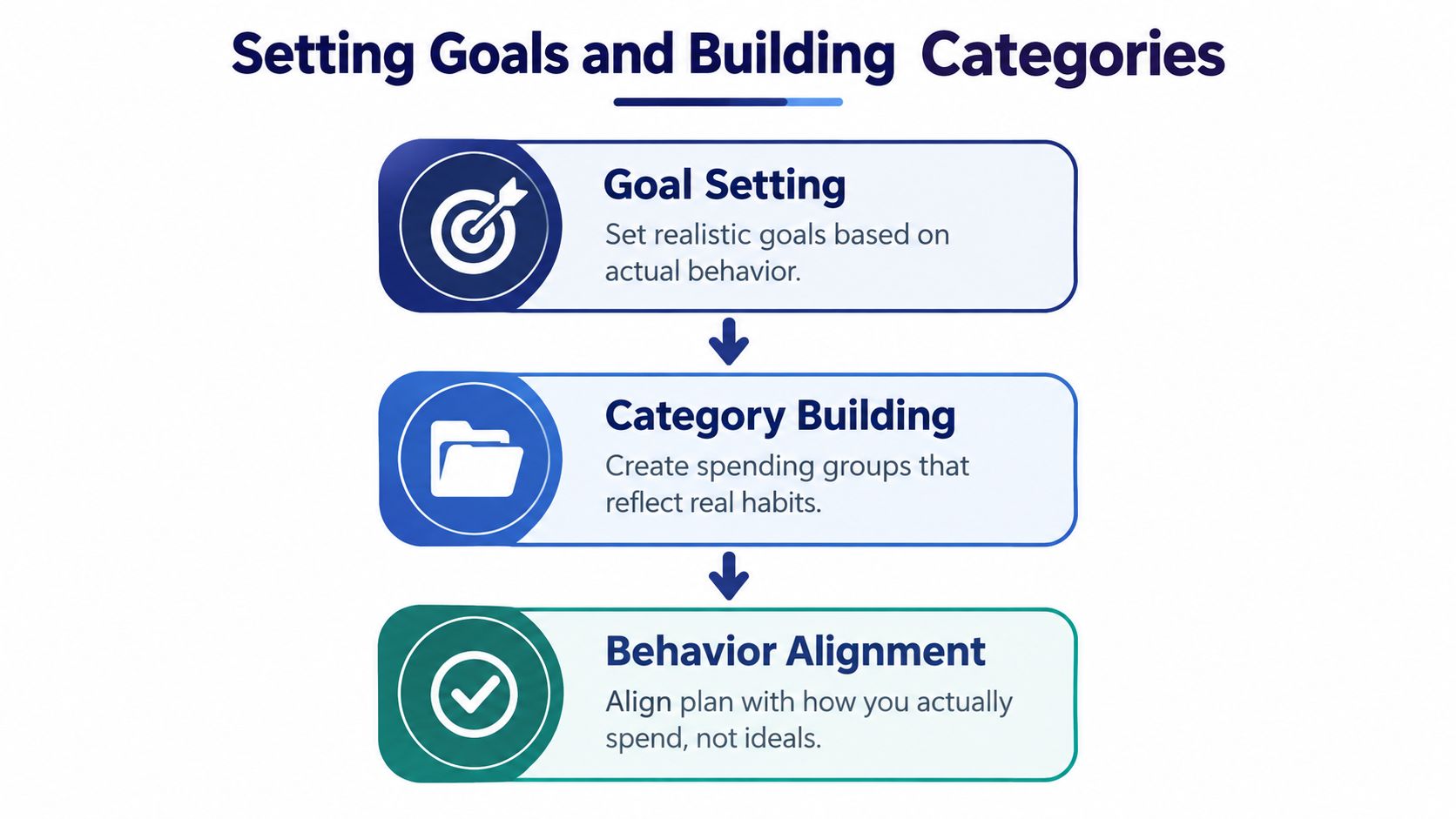
Start with a goal that can guide an actual decision. “Be better with money” is too vague to shape a purchase. “Keep enough available for upcoming essentials” or “set aside money for a planned annual expense” gives the budget a purpose.
Your categories should come from observed behavior, not from an idealized version of yourself. Review recent transactions and group them into broad patterns. If takeaway meals appear often, hiding them under “miscellaneous” won't make them disappear. A visible category gives you the information needed to decide whether to reduce, accept, or plan for that spending.
Build from priorities outward
Use a simple order of operations:
- Protect essentials. Start with housing, utilities, food, transport, insurance, and required payments. Official household data reinforces this priority. Eurostat's survey overview shows that essential categories can take the largest share when income is limited.
- Account for commitments. Add recurring subscriptions, card payments, school costs, or other obligations that must be paid.
- Fund meaningful goals. Include savings, debt reduction, planned purchases, or other targets that matter to you.
- Shape flexible spending. Whatever remains can be divided among leisure, dining, hobbies, and discretionary choices.
Goals should be visible in the plan, even if the first allocation is modest. A goal that appears in the budget can influence everyday choices. A goal kept only in your head has to compete with every immediate purchase.
Build the plan around the person you are today, then use it to make tomorrow's choices more intentional.
Avoid creating a category for every possible transaction. Too much detail can make the system fragile. If two categories lead to the same decision, combine them. If one category repeatedly hides a problem, split it.
Budgeting When Income Is Irregular
A fixed monthly salary is only one financial pattern. Some people are paid by project, commission, shift, contract, or seasonal work. Others have stable income but face expenses that move unpredictably. A plan that assumes the same amount arrives on the same date will create false confidence.
Recent household data shows why cash-flow pressure deserves attention. In the United States, 41% of adults said they always or often had money left over at the end of the month in 2025, according to the official Japanese government source containing the cited household financial data. In Poland, household spending absorbed 57.6% of disposable income in 2025, with only a slight decline from the prior year, according to the same verified data reference. These figures don't describe every household, but they show that a monthly surplus can't be treated as a universal assumption.

Plan for the money you know
Use conservative income assumptions. Base essential commitments on money that has arrived or is highly dependable, rather than treating a possible payment as spendable cash. When income varies, a rolling view can be more useful than forcing every month into the same shape.
Separate expenses into two groups:
- Fixed or committed costs: obligations that must be covered, even when income is lower.
- Flexible costs: spending that can be delayed, reduced, or moved when circumstances change.
A buffer can absorb the difference between a strong period and a lean one. It doesn't need a complicated formula. The important point is to give irregular income somewhere to go before it gets assigned to optional spending.
For practical methods that connect pay timing, essential costs, and flexible categories, use this guide to budgeting with irregular income. The plan should be updated when income arrives, not only at the start of a calendar month.
Monitoring Progress and Adjusting Your Plan
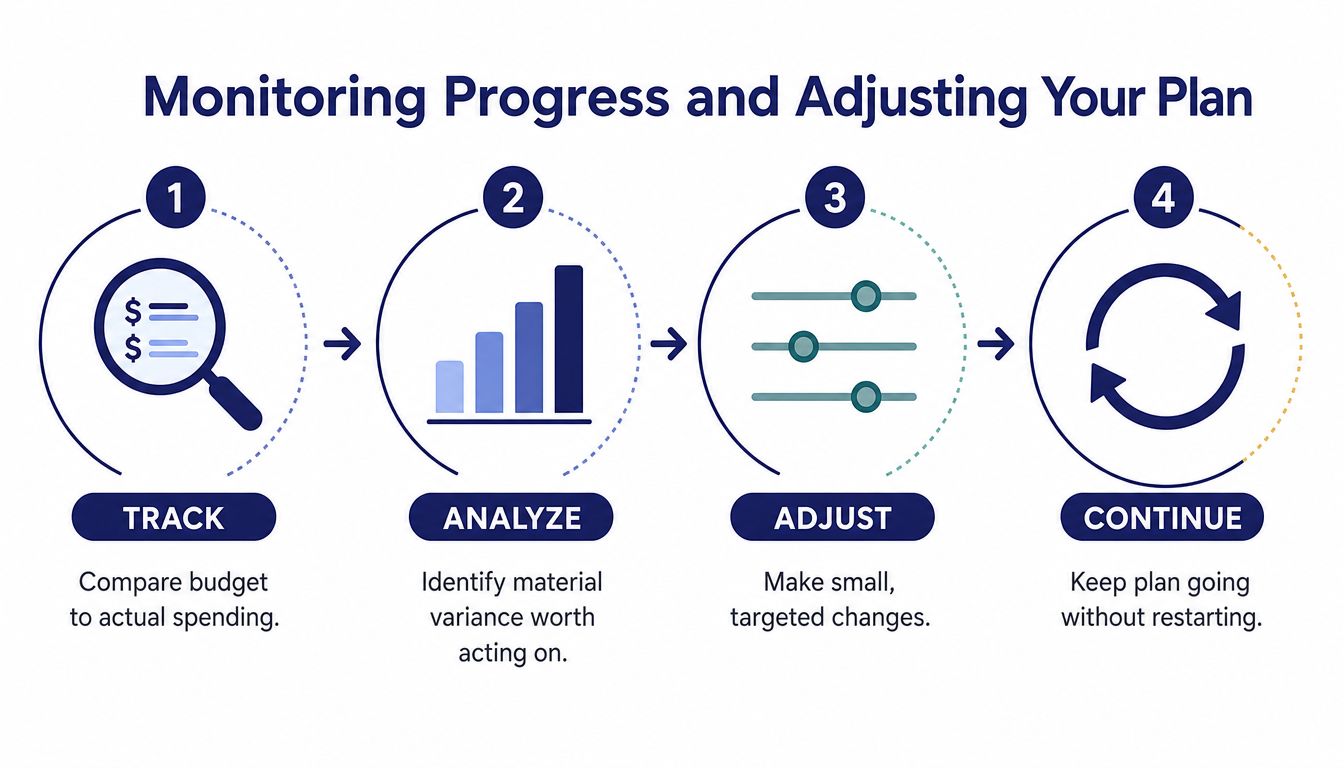
A budget becomes useful when you compare your plan with your actual transactions. This process is called budget-to-actual analysis. You look at what you expected to spend, what you really spent, and the reason for the difference.
Don't treat every small variation as a crisis. The technical guidance on budget control describes material variance as a deviation worth investigating, with about ±10% often used as an operating benchmark for review. The referenced budget-control material presents the purpose clearly: investigate meaningful differences, identify root causes, and take corrective action.
Review the reason, not only the result
A category can exceed its limit for very different reasons. A one-off medical cost, an overlooked annual renewal, rising grocery prices, and repeated impulse purchases require different responses. The number tells you where to look. The explanation tells you what to change.
Use a simple review sequence:
- Compare: place planned and actual amounts side by side.
- Explain: identify whether the difference came from timing, price, frequency, or an omitted expense.
- Decide: adjust the category, move money from a flexible area, or change the next period.
- Continue: keep recording instead of restarting from zero.
Comparing periods is more informative than judging one isolated snapshot. Statistics Denmark describes household budget surveys as annual statements of private consumption, and Greece's 2021 survey recorded average annual household expenditure of 17,037.48 euros, or 1,419.79 euros per month, a 6.6% increase from 2020. The broader lesson is that spending changes over time, so a budget must respond to income shifts, inflation, and household changes.
Forecasting the next few months
A budget covers one period. A forecast looks a few periods ahead, so a large bill or a lean month does not arrive as a surprise.
Keep it simple. List the income you are fairly sure of for the next three months, then the fixed bills, then the irregular ones you know are coming, such as insurance or school fees. Subtract, month by month. If one month goes negative, you know now, and you can set money aside in the months before it.
Redo the forecast when something changes, not on a schedule. A new job, a rent increase or a large purchase is the reason to update it.
How Ledgerly Supports the Budget Planning Process
Ledgerly is a mobile budget and expense tracker that keeps financial records on the device unless you switch on backup, and uses manual transaction entry rather than bank connections. Its Plan view lets you choose a monthly, fortnightly, or between-paydays period, then review progress bars for individual categories. That structure supports the central idea of a dynamic plan: the timeframe can reflect when money arrives.
The Today view calculates a “safe to spend today” figure from remaining funds, upcoming items, and the days left in the selected period. Instead of checking only a total account balance, you get a daily reference that accounts for money already committed. It can be useful when a person has several days left before income arrives and needs to decide whether a discretionary purchase fits.
Coordinating several accounts
The Money view combines cash, checking, savings, and credit balances into a single net total. Transfers between accounts are treated as moves rather than expenses, which helps avoid counting the same money twice. You can also keep separate budgets for household finances and side projects.
Manual entry makes each transaction explicit. You choose the amount, category, and account, then search recorded items by note, category, or amount. Recurring transactions can represent salary, rent, and subscriptions under Upcoming, so expected items remain visible during daily decisions.
The app operates offline on iOS and Android, with optional backups to Google Drive, iCloud, or a local file. It doesn't require an account or bank login. If you're weighing whether a tool fits your habits, this explanation of whether budgeting apps are worth it can help you compare automated and manual approaches.
Your First Steps to a Working Budget Plan
Start with one period and a short list of categories. You don't need to predict your entire financial future before recording your next purchase. Choose the timeframe that matches your income rhythm, then write down the money you expect, the commitments you already know about, and the flexible areas where choices remain open.
A simple first setup might look like this:
- Choose the period. Use a month, fortnight, or pay-to-payday cycle based on when your money arrives.
- Record current balances. Separate actual money from expected income and distinguish transfers from spending.
- List essentials first. Add housing, utilities, food, transport, required payments, and other commitments.
- Add goals and flexible categories. Give savings or planned costs a place, then set realistic limits for optional spending.
- Track transactions as they happen. Don't wait until the end of the period, when memory will fill in the gaps.
- Review meaningful differences. Ask why the plan and reality diverged, then make one targeted adjustment.
Your first version will be imperfect. That's normal. A working budget improves because you use it, observe your behavior, and revise assumptions. The aim isn't to create a flawless monthly envelope. It's to build a clear system that helps you make the next sound decision.
Ledgerly gives you manual transaction tracking, configurable budget periods, category progress, account coordination, and a daily “safe to spend” view without bank connections. Visit Ledgerly to see whether its manual approach fits the way you want to plan, record, and adjust your money.