August 26, 2026
How to Budget with Irregular Income That Actually Holds Up
Learn how to budget with irregular income using a baseline method, layered allocation, and pay-period plans that survive lean months and gig swings.
irregular income budgetvariable incomepay-period budgetfreelance budgetingincome smoothing
Most advice on how to budget with irregular income starts with the wrong number. It tells freelancers, contractors, and gig workers to average their income over six or twelve months, then build a monthly plan around that average. That sounds reasonable until a slow month arrives and the budget suddenly demands money that isn't there.
Irregular income isn't a niche inconvenience. More than 80% of gig workers reported unpredictable income, nearly 3 in 4 reported income swings of 25% or more, and 43% said neither the timing nor amount of their pay was predictable, according to data summarized in research on gig-worker income volatility. A monthly average hides that instability instead of solving it.
The system that holds up is stricter. You need a conservative baseline, a named destination for every deposit, and a buffer that smooths the gap between what you earn and what you need. The money gets assigned when it arrives, not after you've spent the good-month surplus.
Table of Contents
- Why Averaging Your Income Is the Wrong Anchor
- Find Your Conservative Baseline Before You Budget Anything
- The Layered Allocation Order for Every Paycheck
- What Good, Average, and Bad Months Actually Look Like
- Setting Up Pay-Period Budgets in a Mobile Tracker
- Three Failure Modes and the Specific Fix for Each
- The One-Page Checklist to Make This Stick
Why Averaging Your Income Is the Wrong Anchor
Averaging is useful for describing your income. It's a poor rule for deciding what you can safely spend.
Suppose a designer earns $1,800 in one month and $6,400 in another. The average is roughly $3,900. If that designer builds recurring spending around $3,900, the plan already fails in the $1,800 month. The strong month also creates a misleading impression that the higher lifestyle is sustainable.
The problem isn't the arithmetic. The problem is variance. An average treats every month as though it were equally dependable, but irregular earners don't receive income that way. Research cited in a Stanford longevity brief on gig work found that only 11% of gig workers said gig work was their sole income source, while 43% said gig earnings made up less than 10% of total income. The same brief reported substantial income loss in 2020 for gig workers at twice the rate of non-gig workers.
Practical rule: Your average is a measurement. Your lowest dependable month is a spending limit.
Treat each payment as a separate event
A paycheck budget assumes the next paycheck will arrive on schedule. A variable-income budget can't make that assumption. Each deposit needs an assignment before it becomes available for ordinary spending.
The order matters:
- Protect taxes first: Move the tax portion out of reach.
- Protect the baseline second: Fund the account that pays recurring essentials.
- Prepare for uneven obligations: Cover quarterly, annual, and seasonal costs.
- Spend the remainder last: Discretionary money is what's left after the plan is protected.
This approach turns a deposit into a controlled allocation instead of a windfall. A mobile tracker can make those assignments visible, but no app can rescue a budget built around an income number you can't reliably produce.
Penn State Extension recommends using historical income to establish a conservative plan, routing inflows through a holding account, and paying yourself a fixed amount on a schedule in its guidance on budgeting with irregular income. That is the core shift. You aren't trying to predict every month. You're making ordinary spending depend on a number that weak months can support.
Find Your Conservative Baseline Before You Budget Anything
Your baseline is the amount you can safely make available for recurring essentials. It isn't your best month, your hoped-for month, or your total gross revenue.
Start with your records. Gather the last 6 to 12 months of deposits, invoices, and bank statements, as recommended in Penn State Extension's budgeting guidance. Use actual money received where possible, not invoices that haven't been paid.
Build the floor
Put each month's income in order from lowest to highest. The lowest realistic month becomes your starting floor. Then test whether that floor can support the essentials you must pay even when work slows:
- Housing: Rent or mortgage payments.
- Household basics: Utilities and groceries.
- Protection: Insurance and required coverage.
- Debt minimums: Required payments only.
- Work continuity: Necessary phone, internet, transport, or business tools.
Don't confuse gross receipts with spendable income. Taxes and self-employment overhead have to come out before you decide what your household can absorb. The conservative baseline should reflect what reaches your essential-spending plan after those obligations, not what appears at the top of an invoice.
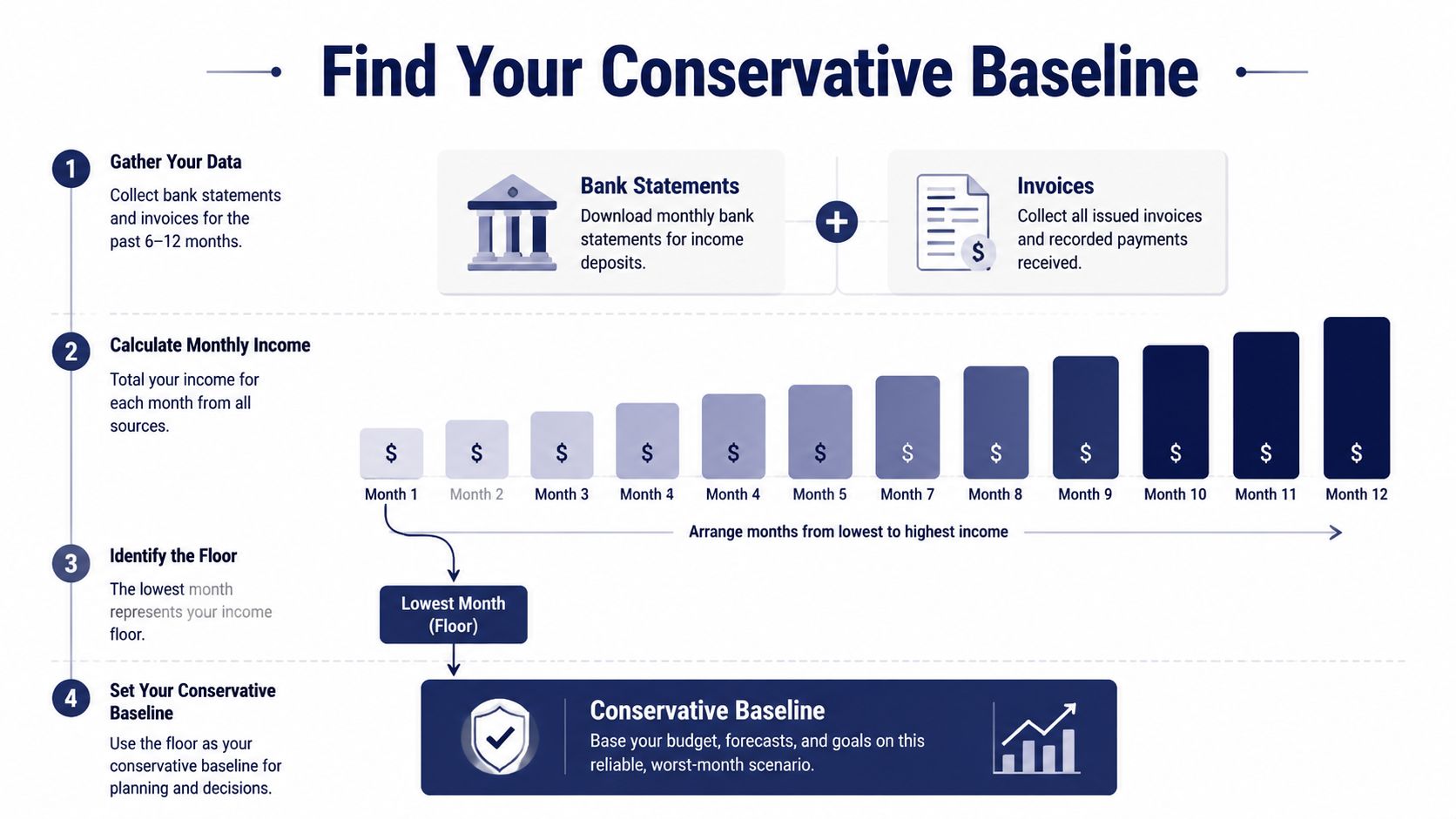
A consultant whose twelve recorded months range from $2,100 to $7,400 might use the $2,100 month as the initial floor. After allowing for taxes and work-related costs, the usable household baseline could be about $1,800. That figure would need to cover rent, utilities, groceries, insurance, and minimum debt payments. The point isn't that $1,800 fits everyone. The point is that the baseline must be derived from the weakest credible income period, then reduced enough to reflect reality.
Test it against history
Run the baseline against every month in your dataset. Ask one question: would this amount have covered the planned essentials in each recorded month?
If the answer is no, the baseline is too high, or your essential costs are too large for the income floor. That result isn't a budgeting failure. It's valuable information. You may need to reduce fixed commitments, increase the buffer target, or create a second income source before treating that baseline as safe.
For a deeper recordkeeping workflow, CSV export examples for personal finance data can help you review historical entries outside the app.
Lock the baseline once it passes the test. Don't recalculate it after every unusually strong payment. Revisit it only when your income history changes materially or your essential obligations change. Re-anchoring after every good month is how a cautious plan turns into lifestyle inflation.
The Layered Allocation Order for Every Paycheck
Every deposit should move through the same sequence. Don't wait until the end of the month to see what's left. By then, the money will have mixed with groceries, subscriptions, eating out, and impulse purchases.
The first destination is the tax bucket. Expert guidance for self-employed and contractor income commonly recommends reserving 25% to 30% of each payment for taxes, as outlined in this freelancer budgeting guide from Beancount. Use a separate account or category, and confirm the appropriate tax treatment for your situation with a qualified tax professional.
Next comes the income-smoothing buffer. The practical target is 1 to 3 months of baseline expenses, a range also identified in the cited guidance. This account handles ordinary income dips. It isn't the same as an emergency fund for medical costs, major repairs, or events that stop you from working.
Then fund irregular obligations. Insurance premiums, software renewals, equipment, professional fees, and quarterly obligations don't disappear because they aren't monthly. Divide each expected annual cost by its payment schedule and reserve the needed share as money arrives.
Only after those assignments should discretionary spending receive a limit.
| Tier | Category | Target Range | Destination Bucket |
|---|---|---|---|
| 1 | Taxes and mandatory deductions | 25% to 30% of each payment for many self-employed earners | Tax-only account |
| 2 | Income-smoothing buffer | Toward 1 to 3 months of baseline expenses | Lean-month buffer |
| 3 | Annual and quarterly obligations | Amount required by each due date | Sinking-fund categories |
| 4 | Discretionary spending and goals | The remaining amount after protected tiers | Spending or goal bucket |
Consider a $4,000 freelance payment. A deliberately rounded allocation might send roughly $1,100 to taxes, $1,200 toward the buffer, $500 to irregular bills, and $1,200 to discretionary spending. Those figures are an illustration of the order, not a universal formula. Your baseline and tax position determine the actual amounts.
The sequence is more important than perfect percentages. If discretionary spending comes first, every later category depends on willpower. If taxes, the buffer, and irregular obligations move first, the amount left for lifestyle spending tells you what you can afford without borrowing from next month's stability.
What Good, Average, and Bad Months Actually Look Like
Maya is a freelance designer with a fixed baseline of $3,000. She doesn't raise that number when a project pays well, and she doesn't pretend the baseline disappears when a client pays late. Her plan gives each period a job before she decides what to buy.
In a strong month, Maya receives $6,200 from a project retainer and a rush logo assignment. The first allocation protects taxes. The next money restores her lean-month buffer, then covers a quarterly obligation and adds to a sinking fund for a future gear upgrade. The remaining amount can support discretionary spending, but the good month doesn't automatically create a permanent new commitment.
Her average month brings in $3,800 from one retainer and smaller gigs. The deposit clears the same allocation order, but there isn't a large surplus after the baseline, taxes, and scheduled obligations are covered. Maya doesn't label that month a failure. The system is doing its job because it prevents a modest surplus from becoming a recurring expense.
The lean month is more revealing. A client delays payment, and Maya receives $1,400. Her baseline stays at $3,000. She protects essential bills and draws the $1,600 gap from the income-smoothing buffer. She doesn't raid the tax category or cancel every future obligation, because those funds already have specific jobs.
| Tier | Good Month ($6,200) | Average Month ($3,800) | Bad Month ($1,400) |
|---|---|---|---|
| Baseline | $3,000 remains fixed | $3,000 remains fixed | $3,000 remains fixed |
| Taxes | Set aside before spending | Set aside before spending | Protected as a separate obligation |
| Buffer | Refilled and topped up | Maintained | Covers the $1,600 baseline gap |
| Irregular costs | Quarterly payment and gear fund | Scheduled costs funded | Existing sinking funds remain separate |
| Discretionary | Limited to the protected remainder | Little or no surplus | Paused while essentials take priority |
Make the period visible
A monthly view can blur the timing of Maya's deposits. A pay-period plan makes the calculation clearer. Each payment enters the holding account, receives its allocation, and supports a defined spending period until the next deposit.
That distinction prevents a common mental error. Maya isn't asking whether she has $6,200, $3,800, or $1,400 to spend. She's asking how much of the current deposit remains after the protected assignments. The tracker shows the answer without allowing the gross deposit to masquerade as spendable cash.
A good month should make the next weak month easier. An average month should keep the machine running. A bad month should activate the buffer, not force a complete reinvention of the budget.
Setting Up Pay-Period Budgets in a Mobile Tracker
A variable-income budget becomes useful when the system reflects the dates money arrives. A monthly plan can still work for fixed bills, but daily spending needs a shorter and more honest window.
Start with daily capacity
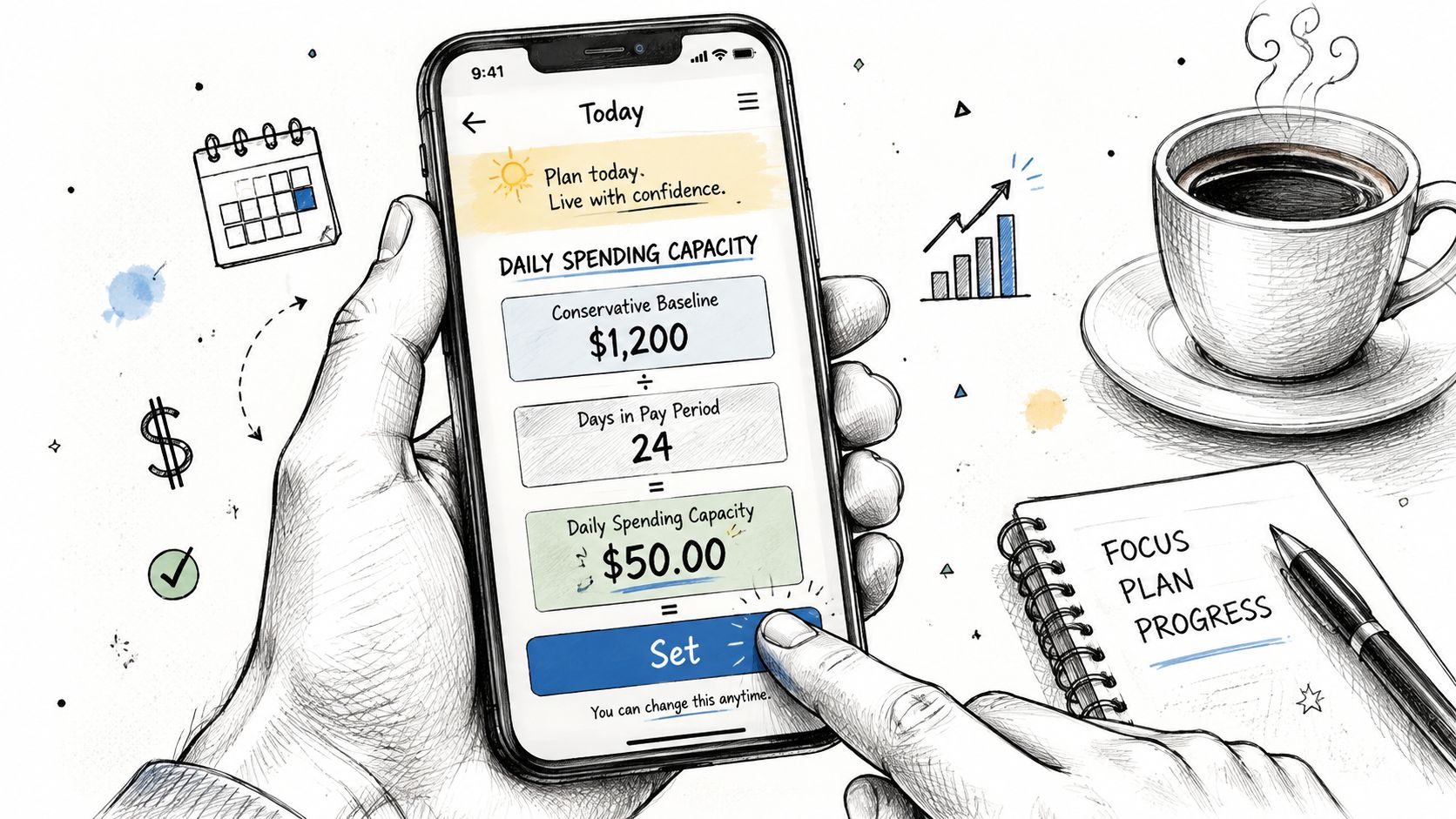
Open the Today view and set daily spending capacity from the conservative baseline, adjusted for the number of days in the period. Don't calculate it from the total gross income expected for the month. Expected income isn't available cash, and it shouldn't inflate today's spending limit.
The daily figure should also exclude money already assigned to taxes, the buffer, and irregular obligations. If a transfer is moving money between your own accounts, record it as a transfer rather than an expense, or you risk counting the same funds twice.
Let payday define the plan
In Plan, change the period from a standard monthly cycle to Between Paydays. Each deposit becomes a contained mini-budget that runs until the next expected payment. That setting is especially useful when a retainer arrives on one date, project work arrives unpredictably, and royalty income lands on another schedule.
Create separate budgets for separate income streams. Keep the retainer client, side project, royalty, and household income distinct instead of blending everything into one pot. Separate budgets show whether a slow retainer month is a household problem or whether another income stream is carrying the plan.
Keep protected money out of daily spending
Create a dedicated category for tax-set-aside transfers and exclude it from the daily capacity calculation. Do the same for the income-smoothing buffer and sinking funds. Those balances may appear in your total money, but they aren't available for today's coffee, fuel, or online purchase.
Ledgerly is one mobile option that combines manual transaction entry, recurring items, Today and Plan views, multiple budgets, account transfers, and on-device storage without requiring bank connections. Its day-to-day expense tracking workflow can support a manual payday routine for people who want to review each transaction themselves.
The behavioral payoff is simple. On payday, you open the tracker, enter the deposit, apply the pre-decided allocation, and check the new period's capacity. The review should take less than a minute once the categories and periods are configured. The app isn't making the financial decision for you. It's making the decision visible and repeatable.
Three Failure Modes and the Specific Fix for Each
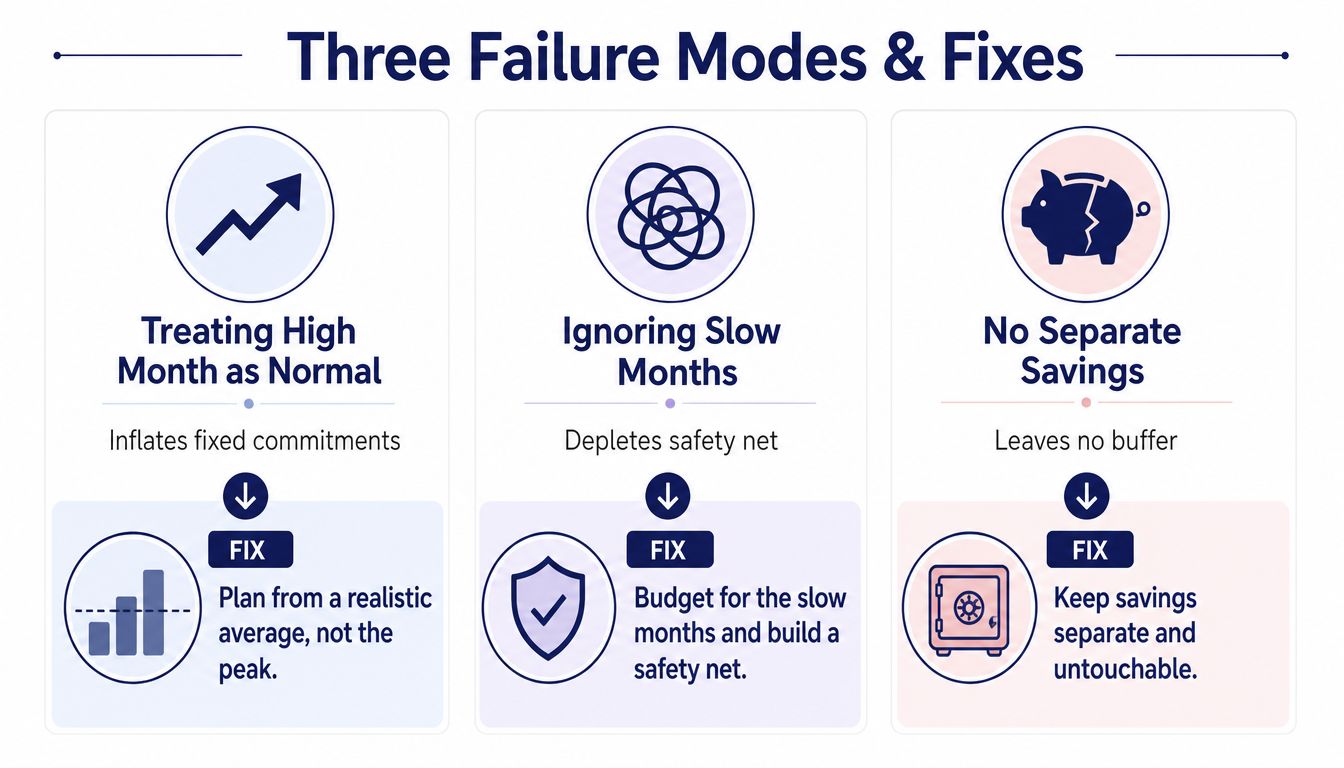
Irregular-income budgets usually don't collapse because the owner can't add. They collapse because one optimistic assumption gets promoted into a permanent rule.
Failure one is turning the high month into a lifestyle
A strong payment arrives, and the earner raises recurring commitments. A larger apartment, more subscriptions, a financed purchase, or a higher weekly spending target all feel manageable while the deposit is fresh. The next slow period exposes the problem.
Fix: Re-anchor recurring spending to the conservative baseline. Review the trailing history periodically, using the lowest realistic month rather than the highest recent month. A stronger month can fund goals or replenish the buffer, but it shouldn't automatically raise fixed commitments.
Failure two is treating taxes as a future problem
Self-employed workers often know a tax bill is coming, yet leave the money in the operating account because the payment date feels distant. That money then gets absorbed by ordinary spending.
Fix: Transfer 25% to 30% of each payment into a tax-only category when the money arrives, following the range in Beancount's variable-income budgeting guidance. Keep that category out of daily spending capacity. If your tax position differs, have a tax professional set the correct reserve.
Failure three is combining the buffer with emergency savings
An income buffer pays for normal low-income periods. An emergency fund protects against a genuine disruption or major unexpected cost. When both sit in one account, a car repair or medical bill can consume the money needed to pay yourself during the next slow month.
Fix: Name the accounts by job. Hold the lean-month buffer separately from the true emergency fund, even if both are savings accounts. Refill the buffer after a draw before increasing discretionary plans.
The useful distinction is operational, not cosmetic. You should know which balance can smooth a weak month and which balance is reserved for an event that threatens your ability to earn or meet essential costs.
The One-Page Checklist to Make This Stick
A complicated budget invites avoidance. Use a short ritual that you can repeat every time income arrives.
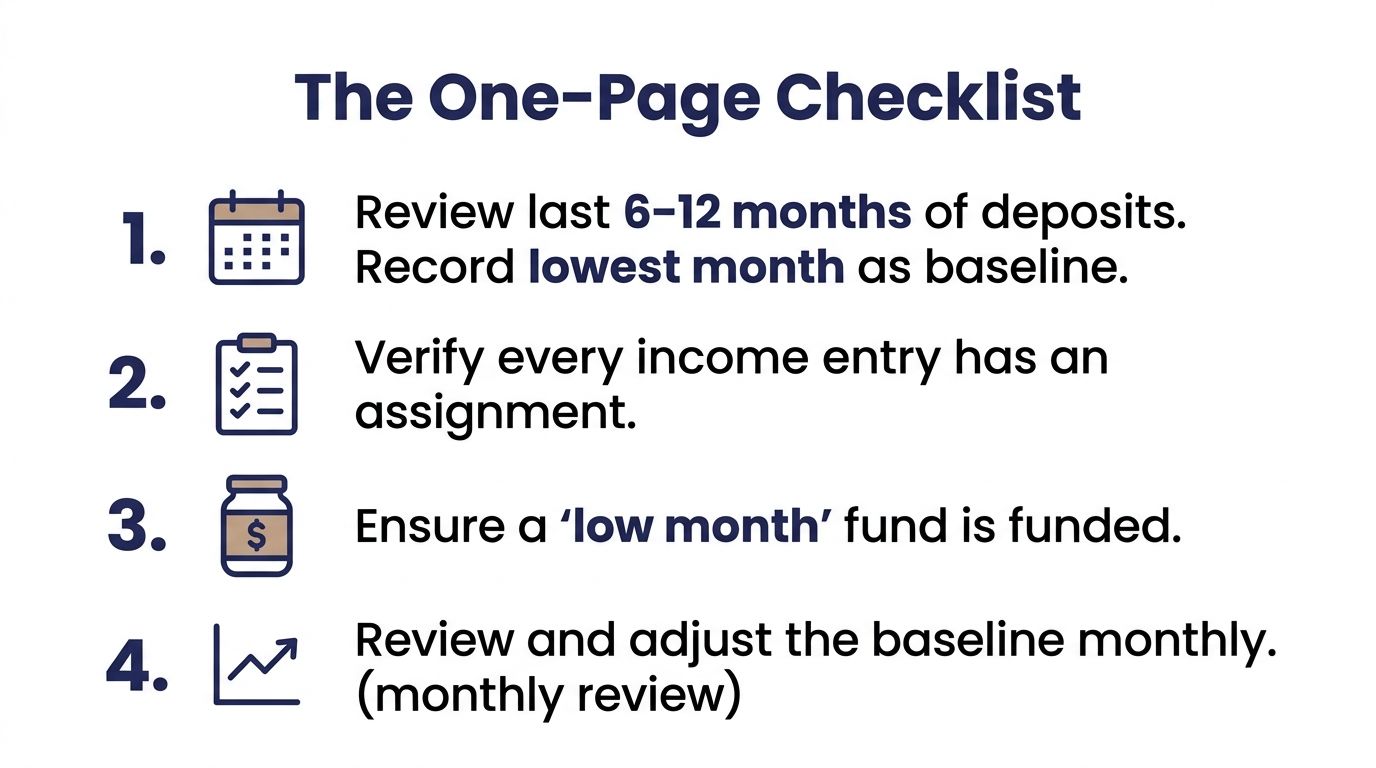
- Review the record: Look back over 6 to 12 months of deposits and identify the lowest realistic month. Use it to set a conservative baseline, then test that baseline against the recorded history.
- Verify every assignment: Before spending, confirm that the deposit has a destination for taxes, baseline essentials, the income buffer, and annual or quarterly obligations.
- Fund the low-month account: Choose a buffer target based on your baseline and the volatility of your work. Keep it separate from a true emergency fund, and refill it after any lean-month draw.
- Set the spending period: Plan between actual paydays, check daily capacity, and keep client work, side income, and household money in separate budgets when that improves visibility.
- Protect the surplus: In a strong month, restore the buffer and fund scheduled obligations before increasing lifestyle spending.
- Handle the lean month: Pay essentials first, draw only the baseline gap from the buffer, and never disguise an unpaid tax obligation as discretionary spending.
- Review the baseline: At the end of the period, compare actual income with the baseline and record any major change in income or obligations.
The system gets easier as the buffer grows. A larger buffer means fewer emergency decisions during lean months, and fewer emergency decisions make it easier to follow the same allocation order without panic or feast-or-famine spending.
If you're deciding whether a mobile tool belongs in your routine, this guide to whether budgeting apps are worth it can help you compare convenience, privacy, and the amount of control you want over each entry.
Ledgerly gives irregular earners a private, manual way to track deposits, assign money to categories, set pay-period plans, and check daily spending capacity without linking a bank account. Visit Ledgerly to see whether its Today and Between Paydays workflows fit the baseline and buffer system you'll use for your next payment.