September 13, 2026
7 Best Budgeting App Picks for Every Money Style
Compare the best budgeting app options for privacy, zero-based planning, automation, spreadsheets, and shared household budgets in 2026.
best budgeting appbudgeting appspersonal finance appsbudget plannerexpense tracker
The best budgeting app depends on the control you want: Ledgerly is the strongest fit for privacy-first manual budgeting, while YNAB, Monarch Money, Quicken Simplifi, Copilot Money, Tiller, and Goodbudget suit different methods, automation preferences, collaboration needs, and price expectations. Budgeting apps are used by 20.9% of respondents in a 2025 Academy Bank survey, while 45.3% use some kind of digital money-management solution, so the category is useful without being universal.Academy Bank's 2025 survey
The popular advice is to pick the app with the most connections, dashboards, and automated insights. That's incomplete. The better question is whether you want to enter every transaction yourself, assign every dollar to a category, plan jointly with a household, forecast upcoming cash flow, let automation do the cleanup, work inside a spreadsheet, or start with a free plan.
This comparison focuses on budgeting method, account connectivity, collaboration, forecasting, platform fit, pricing transparency, privacy model, and maintenance burden. Ledgerly is the publisher's product, and that relationship should be clear. It's included alongside the alternatives and assessed against the same practical criteria, not treated as a universal winner.
The budget-app market is projected to grow from about USD 247.21 million in 2025 to USD 421.87 million by 2035, at a projected 5.49% CAGR, according to Dataintelo's budget-app market data. That growth doesn't make one method right for everyone. It makes the trade-offs more important.
Table of Contents
- 1. Ledgerly
- 2. You Need a Budget
- 3. Monarch Money
- 4. Quicken Simplifi
- 5. Copilot Money
- 6. Tiller
- 7. Goodbudget
- Top 7 Budgeting Apps, Side-by-Side Comparison
- Choose the Workflow You Will Actually Maintain
1. Ledgerly
Ledgerly gives users the most direct control in this comparison. It is a privacy-first mobile budget and expense tracker for iOS and Android that keeps financial data on the device. You do not need an account or bank login, and transactions are not stored on a server. Data stays on the phone unless you deliberately enable backup to Google Drive, iCloud, or a local file.
That approach fits people who avoid bank aggregation, need offline access, or want to decide exactly how each transaction is categorized. You enter the amount, account, and category yourself. Recurring items can cover salary, rent, subscriptions, and other predictable entries. Manual entry takes more attention than automatic importing, but it avoids guessed categories and delays from bank postings.
The useful part is the daily decision
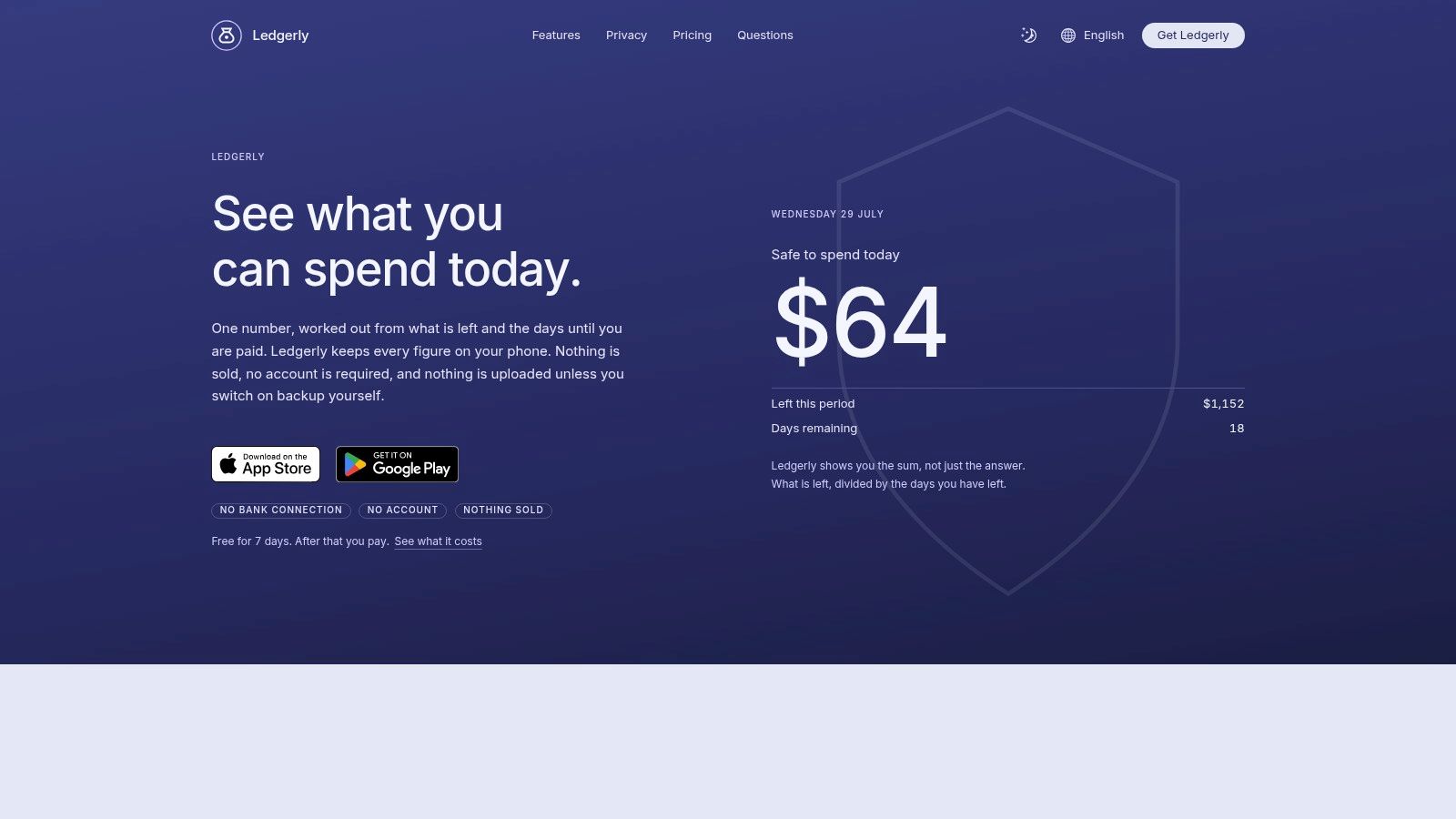
Ledgerly uses four tabs, Today, Plan, Money, and Tools, without burying the main task under layers of dashboards. Today calculates one “safe to spend today” figure from remaining funds, upcoming items, and the days left in the selected period. Plan supports monthly, fortnightly, or between-payday periods, which helps when income does not follow a standard monthly schedule.
Money combines cash, checking, savings, and credit into one total. Transfers count as movements rather than expenses, so shifting money between your own accounts does not inflate spending. You can also maintain separate budgets for household finances or side projects, correct an account balance with one adjustment line, search by note, category, or amount, and export recorded data as CSV.
Practical rule: Choose Ledgerly if you would rather enter transactions yourself than give an app ongoing access to your bank accounts.
Ledgerly includes a 7-day free trial that begins after setup. Payment is required to add new transactions after the trial, with monthly, yearly, or lifetime purchase options available through the App Store or Google Play. Existing data remains available for reading, searching, exporting, and backing up without purchase.
The trade-off is clear. Ledgerly does not provide hands-off importing, automatic categorization, or financial coaching. It is designed for manual accuracy, on-device privacy, flexible pay-cycle planning, and a clear daily spending figure. Current availability and store pricing are listed on the Ledgerly website.
2. You Need a Budget
YNAB is the strongest choice when the budgeting method matters more than convenience. Its zero-based approach asks you to assign available money to categories and make deliberate decisions about immediate spending, future obligations, and larger goals. That creates more structure than a general spending tracker, but it also asks you to learn and maintain the system.
The app supports manual entry and optional bank syncing, so you can use it with a hands-on workflow or reduce some of the data-entry burden. Its category goals, detailed reports, and “Age of Money” insight help users evaluate not just where money went, but how their planning affects the timing of spending. YNAB also provides workshops and educational resources, which can be valuable if you want a method rather than another dashboard.
Best for envelope discipline
YNAB works particularly well for users who need a firm decision framework. A category with no available money creates a prompt to adjust the plan, rather than allowing spending to drift. That precision can help households make trade-offs before a purchase instead of explaining them afterward.
The cost is involvement. New users may find the terminology and workflow demanding, especially if they're accustomed to a simple monthly expense list. The subscription sits at the higher end of the options here, although one subscription can be shared with up to six household members, according to the product details supplied for this comparison.
For a detailed comparison of the two manual-control approaches, see Ledgerly versus YNAB. Ledgerly is simpler and more privacy-focused because it avoids bank connections entirely. YNAB is more method-driven, with stronger education, deeper goal mechanics, and optional automation.
Choose YNAB if you're willing to give every dollar a job and review the plan actively. Don't choose it because zero-based budgeting sounds impressive. Choose it because you want the discipline built into the workflow.
3. Monarch Money
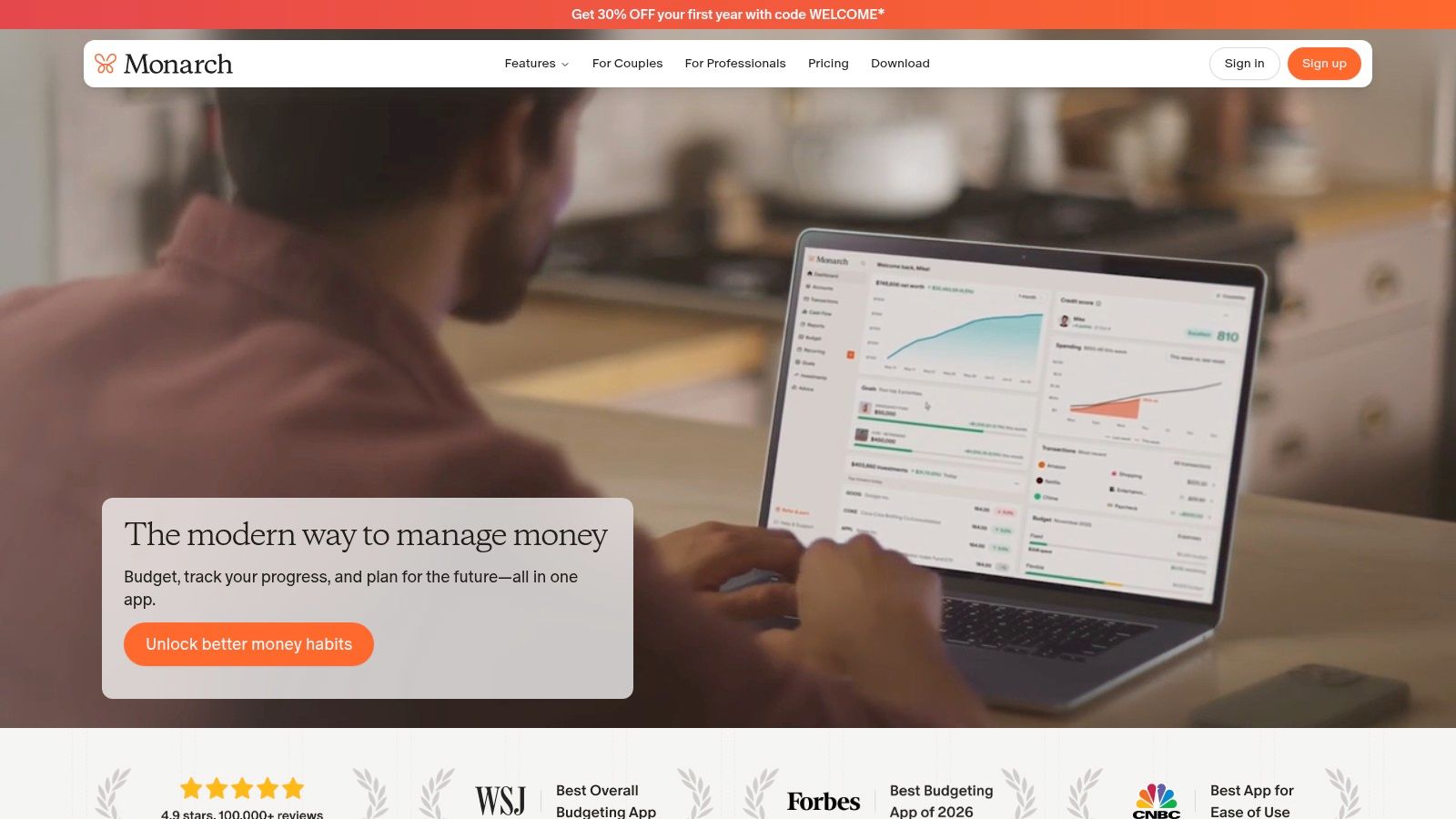
Monarch Money is built for people who want a shared household financial picture without forcing every person to maintain a separate system. It connects cash, cards, loans, and investments into one view, then layers budgeting, net-worth tracking, and forward-looking cash-flow planning on top.
That connected approach is the opposite of Ledgerly's manual privacy model. Monarch is valuable when the main problem is fragmentation. If you and a partner have multiple accounts, recurring obligations, and different spending responsibilities, a unified dashboard can reduce the need to reconcile information across separate apps.
Best for household collaboration
The collaboration model is Monarch's defining advantage. Multiple household users can work from the same financial context, which makes it easier to discuss budgets, upcoming cash flow, and net worth without passing spreadsheets back and forth. Web and mobile access also make the system practical for households that don't use the same device or platform.
The app is ad-free and doesn't sell user data, with development funded through subscription revenue. That's a meaningful privacy position, but it doesn't mean Monarch is a no-connection product. You still need to decide whether the convenience of account aggregation justifies maintaining those connections.
A clean shared dashboard helps only when both people trust the data and agree on the categories.
Monarch doesn't offer a permanent free plan. Pricing details appear at checkout and can change, so check the current offer before committing rather than relying on an old comparison. The app is best for couples and families who value collaboration, connectivity, and forecasting more than manual transaction-by-transaction control. Try Monarch Money if your money problem is scattered information. Look elsewhere if your first requirement is keeping every record offline.
4. Quicken Simplifi
Quicken Simplifi focuses on the question many beginners ask: what bills and spending are coming up, and how much room is left afterward? It uses connected account data to create projected cash flow, track upcoming bills and subscriptions, and show the month ahead without requiring users to build a complex budgeting structure first.
Its watchlists and category targets give you spending guardrails without demanding the full envelope discipline of YNAB. Savings goals and subscription tracking add practical context, especially if recurring charges are difficult to monitor manually. The web and mobile experience also make it accessible to users who want more than a phone-only tool.
Best for forecasting without a heavy method
Simplifi's advantage is approachability. You can see expected income, planned spending, and upcoming obligations in a forward-looking view, which is more useful for some people than a retrospective category report. It's a good match for a beginner who wants to anticipate a tight week rather than study last month's patterns.
The trade-off is the account connection. Simplifi is bank-linked, so it offers limited value to someone who refuses aggregation or wants fully explicit transaction entry. Promotional pricing can also apply during an introductory period, after which the subscription renews at then-current rates. Check the renewal terms before treating the first offer as the long-term cost.
For a different approach to planning by pay cycle, compare it with this budget planner app guide. Quicken Simplifi makes sense if you want cash-flow projections, bill planning, and a low-friction start. It isn't the right pick for offline privacy or meticulous manual categorization.
5. Copilot Money
Copilot Money is the automation-first option for users who want a polished interface to do most of the sorting. It automatically categorizes transactions and improves its categorization over time, while budgets, rollovers, cash-flow summaries, and subscription detection help turn the imported data into a usable spending picture.
The app also tracks investments and net worth, including real estate, so it reaches beyond a narrow expense tracker. Its support for iPhone, iPad, Mac, and web gives Apple-heavy households a consistent experience across screens. The interface is calm and visually organized, which can make regular check-ins easier than working through a dense financial dashboard.
Convenience is the product
Copilot is a good fit when manual entry is the friction you're trying to remove. Automated categorization means you spend less time recording routine purchases and more time correcting exceptions or reviewing trends. That convenience has a cost in control, however. Auto-categorization can misunderstand unusual transactions, transfers, reimbursements, or purchases that don't fit standard labels.
Copilot has no ads or data selling and presents a clear privacy stance, but it still depends on connected accounts. It's also limited to U.S. accounts and institutions, so international users need to rule it out before comparing its workflow with the other apps.
Automation saves effort, but it also creates a review job. If you won't check questionable categories, the speed can undermine accuracy.
There's no permanent free plan, and the product is designed for users who prefer automated account management rather than a manual-only process. Choose Copilot Money for fast categorization, design quality, investment visibility, and Apple plus web access. Choose Ledgerly or Goodbudget if entering transactions yourself is part of the control you want.
6. Tiller
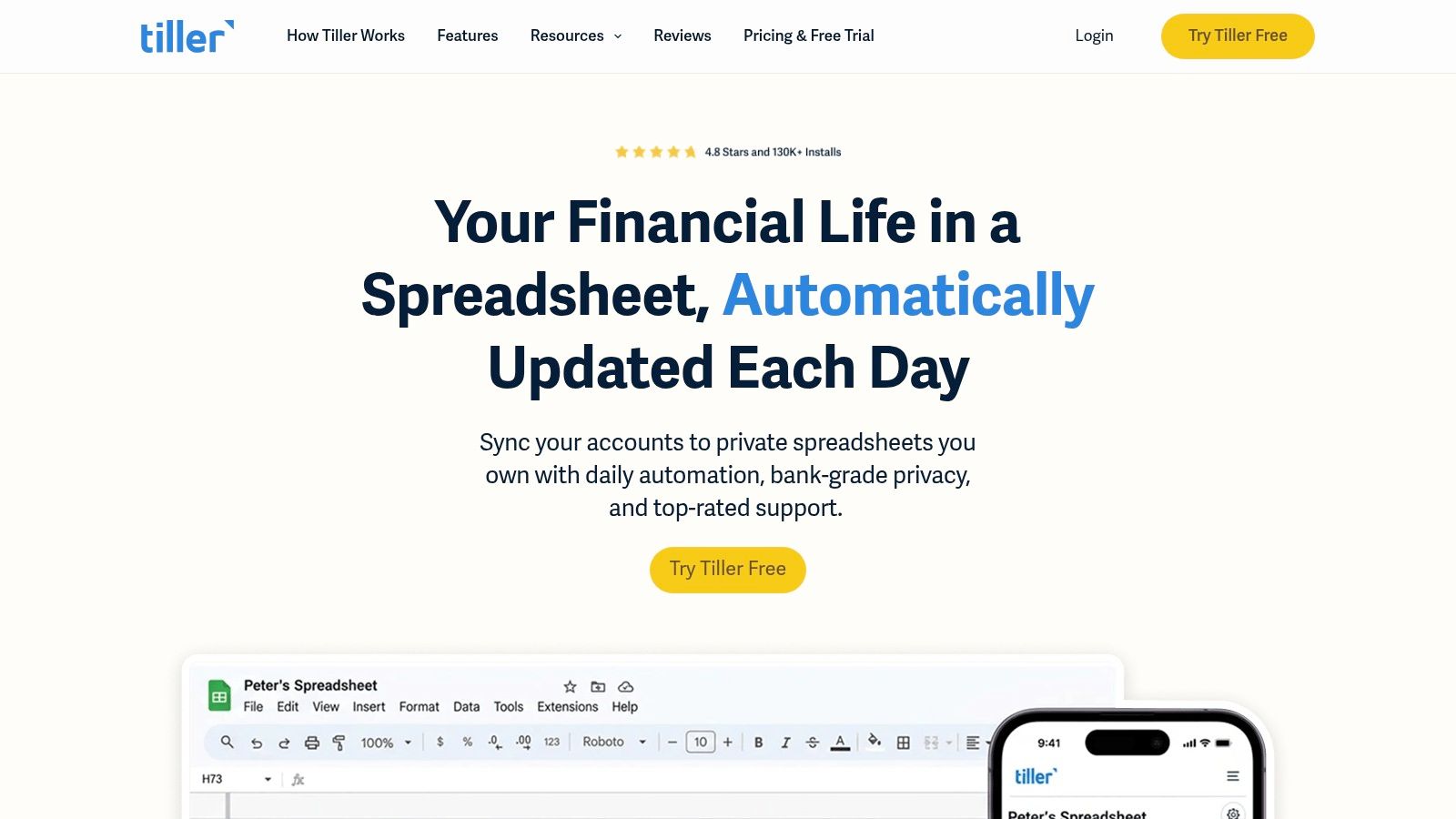
Tiller gives spreadsheet users a budgeting system without asking them to abandon the tools they already understand. It sends daily transaction feeds into Google Sheets or Microsoft Excel, where you can use templates, formulas, filters, and custom reports to build a financial workflow that matches your preferences.
That flexibility makes Tiller different from every app-first option in this list. You can inspect the underlying rows, alter category rules, build a debt-payoff view, create a net-worth report, or redesign the workbook around your own priorities. Foundation templates provide a starting point for monthly and annual budgets, while add-on templates extend the system for more specialized work.
Best for auditability and customization
Tiller suits people who want to know how a number was calculated. A spreadsheet exposes the inputs and formulas, which can make troubleshooting easier than interpreting an opaque score or automated summary. Daily email summaries and an active help center and community provide structure, but the main value remains the editable spreadsheet environment.
The drawback is maintenance. You'll need to be comfortable with spreadsheets, and setup requires more attention than opening a mobile app and accepting its default categories. A customized workbook can become powerful, but it can also become fragile if you keep changing formulas without documenting the logic.
Tiller is best for a user who enjoys building systems, not someone seeking the smallest possible daily task. Tiller offers the most spreadsheet flexibility, transparency, and custom reporting in this comparison. It won't feel lightweight if your ideal budget is a short daily check-in.
7. Goodbudget
Goodbudget is the practical free-entry choice for envelope budgeting. You assign money to digital envelopes, record spending manually, and use the categories to see what remains for each purpose. The system is familiar, visual, and less intimidating than a full financial command center.
Its free plan supports manual envelope-style budgeting, which makes it useful for someone who wants to test the method without paying first. Goodbudget also supports shared household budgets across web and mobile, with Premium adding features such as bank syncing for U.S. banks, more envelopes and accounts, multi-device support, and extended history.
Best for a simple envelope system
Goodbudget's manual workflow is a feature when you want to make a conscious choice before spending. It gives each category a visible limit, so the method is easy to explain to a partner or family member. Debt tracking and simple reports add useful context without turning the product into an investment dashboard.
Its limitations are just as clear. Premium bank syncing is restricted to U.S. banks, and reporting and automation are simpler than the tools built for forecasting or power-user analysis. If you need a detailed net-worth model, advanced projections, or extensive automated cleanup, Goodbudget may feel narrow.
The best budget apps without bank linking also include Ledgerly, which goes further on local storage and flexible budget periods. Goodbudget remains the better starting point if free access and envelope discipline matter most. Visit Goodbudget when you want a lightweight shared method, not a fully automated financial command center.
Top 7 Budgeting Apps, Side-by-Side Comparison
| Product | Implementation Complexity 🔄 | Resource Requirements ⚡ | Expected Outcomes 📊 | Ideal Use Cases 💡 | Key Advantages ⭐ |
|---|---|---|---|---|---|
| Ledgerly | Low, simple 4‑tab, manual workflow 🔄 | Low device needs; high user time for entries ⚡ | Precise manual control, strong privacy 📊 | Privacy‑first users, irregular pay cycles, hands‑on budgeters | On‑device by default, with backup the only thing that copies data off, "safe to spend" Today view, flexible periods |
| You Need a Budget (YNAB) | Moderate–High, rule‑based learning curve 🔄 | Moderate, subscription; optional bank sync ⚡ | Excellent behavior change, detailed reporting 📊 | Users wanting zero‑based budgeting and education | Proven methodology, goals/tools, family sharing |
| Monarch Money | Low, polished, connected UX 🔄 | Moderate, subscription; bank connectivity ⚡ | Unified tracking and forecasting for households 📊 | Couples/families needing consolidated view & forecasts | Ad‑free, strong connectivity, forward cash‑flow tools |
| Quicken Simplifi | Low, approachable, bank‑linked setup 🔄 | Moderate, subscription within Quicken ecosystem ⚡ | Clear cash‑flow projections and bill planning 📊 | Beginners wanting forward‑looking monthly planning | Excellent projection tools, subscription tracking |
| Copilot Money | Low, automation/AI‑first setup 🔄 | Moderate, subscription; U.S. accounts focus ⚡ | Fast insights, reduced manual cleanup 📊 | Users who want fast automation and clean UI (U.S.) | Auto categorization, calm UI, privacy stance |
| Tiller | High, spreadsheet setup & maintenance 🔄 | Moderate–High, Sheets/Excel skills and upkeep ⚡ | Maximum transparency and custom reporting 📊 | Power users who prefer spreadsheets and audits | Bank feeds into sheets, templates, add‑on ecosystem |
| Goodbudget | Low, manual envelope workflow 🔄 | Low, generous free plan; Premium adds sync ⚡ | Simple envelope budgeting and shared planning 📊 | Envelope‑style users and households on a budget | Free manual plan, multi‑device sharing, approachable |
Choose the Workflow You Will Actually Maintain
The best budgeting app is the one whose central workflow matches the way your money arrives and the way you make decisions. A connected dashboard isn't automatically better than manual entry, and a detailed method isn't automatically better than a simple spending view. The right choice depends on what you're willing to maintain after the initial setup.
Choose Ledgerly if you want on-device privacy, no bank login, offline access, manual accuracy, and a computed “safe to spend today” figure. Its flexible monthly, fortnightly, and between-payday plans make it especially suitable for irregular income or anyone who plans around actual paydays. The trade-off is that you must enter transactions yourself.
Choose YNAB if you want a structured zero-based method with detailed categories, goals, education, and active household participation. Choose Monarch Money if collaboration, connected accounts, net-worth tracking, and forward-looking household planning matter more than local-only storage. Choose Quicken Simplifi if you want approachable projections, bill planning, and a clear view of upcoming cash flow without learning a demanding budgeting philosophy.
Choose Copilot Money if you prefer automation-first categorization, a polished Apple and web experience, and investment visibility. Choose Tiller if you want spreadsheet-level control, inspectable formulas, and limitless customization. Choose Goodbudget if you want a free or lightweight envelope system that works manually and can be shared across a household.
Test the workflow against your real payday cycle, account structure, privacy requirements, and tolerance for manual entry. A budgeting app that looks excellent in a product tour can still fail if its central task feels tedious or its account model conflicts with your boundaries.
Start with one app. Enter your current balances and recurring items, select the budget period that matches your income, and review whether its daily or forward-looking view answers the money question you care about most. If you need to know what you can safely spend today, use that as the test. If you need to know whether the month will cover upcoming bills, judge the app by its projection instead.
Ledgerly offers on-device budgeting for iOS and Android, manual transaction entry, optional recurring items, offline access, CSV export, and a “safe to spend today” view without bank connections. Visit Ledgerly to see whether its privacy-first workflow fits the way you want to manage money.