August 25, 2026
Chemistry Percent Abundance a Clear Guide
Learn chemistry percent abundance with clear examples. Understand isotopic ratios, weighted atomic mass calculations, and practice problems step by step.
percent abundanceisotopesatomic masschemistry tutorialweighted average
If every atom of an element has the same number of protons, why doesn't the periodic table give that element one clean whole number? That's the question students ask right before the quiz, and the answer is that the periodic table is showing a weighted average, not the mass of one atom.
Chemistry percent abundance is the calculation tool that turns a natural mix of isotopes into that single decimal value. Once you see how the weights work, the decimal on the periodic table stops looking mysterious and starts looking like a result you can build yourself.
Table of Contents
- Why Percent Abundance Matters Before You Learn the Math
- Defining Isotopes and Percent Abundance in Plain Language
- Calculating Average Atomic Mass Step by Step
- Comparing Single Isotope Elements With Multi Isotope Elements
- Three Worked Practice Problems With Full Solutions
- Where Percent Abundance Shows Up Beyond the Textbook
- Common Misconceptions That Trip Students Up
- Recap Checklist and One Stretch Problem to Try
Why Percent Abundance Matters Before You Learn the Math
A class average only makes sense once you know each student's score and how much each score counts. If one exam counts far more than a quiz, the average moves toward the exam score even when the quiz is perfect. Atomic mass works the same way, because an element in nature is usually a blend of isotopes, and each isotope contributes according to how common it is.
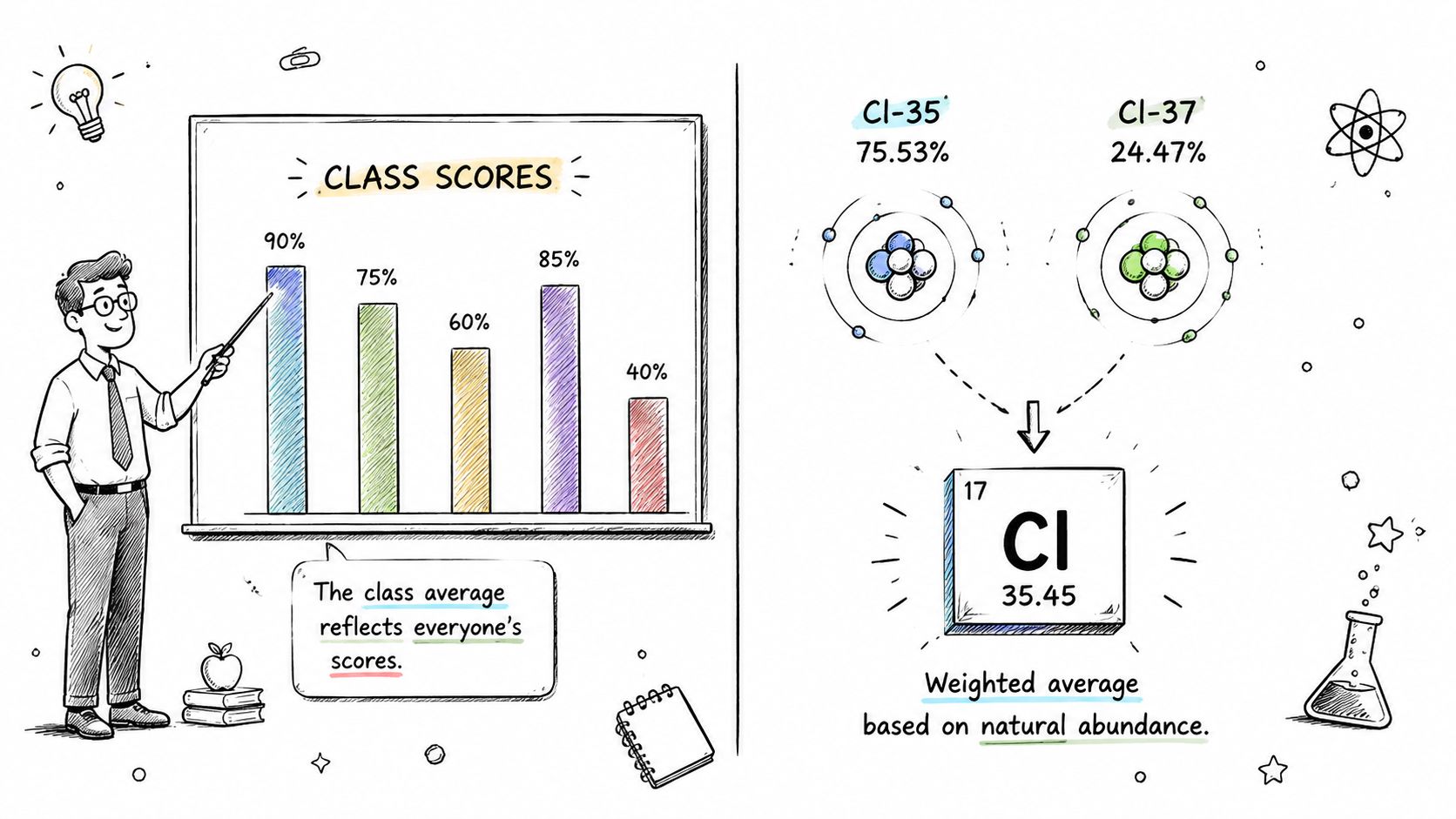
That is why the periodic table rarely shows a whole number. The listed value is a weighted average atomic mass because the table reflects a natural blend of isotopes, not the mass of a single isolated atom. In chemistry percent abundance problems, the task is to find how much of each isotope is present and how much each one should count.
Practical rule: the isotope that appears most often usually drives the average, but the smaller isotopes still matter because the average is a sum, not a guess.
The payoff works in two directions. If you know the isotopes and their abundances, you can predict the atomic mass. If you know the atomic mass and most of the isotope data, you can work backward to find the missing abundance. That reverse problem is where many students freeze, because they have learned the idea of isotopes but have not yet practiced treating abundance like a number they can solve for.
Defining Isotopes and Percent Abundance in Plain Language
An isotope is an atom of the same element that has the same number of protons but a different number of neutrons, so it has a different mass number. Chlorine is a clean example because it naturally occurs as two stable isotopes, chlorine-35 and chlorine-37. Same element, same chemistry, different mass.
Percent abundance, also called relative abundance or fractional abundance, is the percentage of atoms in a natural sample that belong to one specific isotope. If 75.53% of chlorine atoms are chlorine-35, that means a natural sample of chlorine is mostly chlorine-35, with the rest made up of chlorine-37. The exact percentages for the chlorine example appear in the worked math later, but the important point here is the pattern, not the memorization.
The one rule that solves most problems is simple. All isotope abundances for one element must add to 100%. If they don't, something is missing or copied wrong.
For calculations, percentages get turned into decimals. That matters because the weighted-average formula uses multiplication, and multiplying by a percentage written as 75.53 is not the same thing as multiplying by 0.7553. Students usually lose the point right there, not because the chemistry is hard, but because the arithmetic started in the wrong form.
Quick check: if an element has only two isotopes, and one is 75.53%, the other must be 24.47%. There's no third place for the missing percentage to hide.
Calculating Average Atomic Mass Step by Step
How do chemists turn isotope data into one atomic mass on the periodic table? The method is a weighted average, and the calculation is straightforward once each piece is in the right form. Average atomic mass is the sum of each isotope's mass multiplied by its fractional abundance. Written as symbols, it looks like this:
average atomic mass = Σ(mass × fractional abundance)
Oxygen gives a clean first example. Natural oxygen is mostly ¹⁶O at 99.759%, with ¹⁷O at 0.037% and ¹⁸O at 0.204%. That mix is why oxygen's average atomic mass is 15.999 amu instead of exactly 16 amu. The small amounts still matter because each one pulls on the average a little. LibreTexts isotopes overview/02:_Atoms_Molecules_and_Ions/2.02:_Isotopes)
Start by converting each percent to a decimal.
- ¹⁶O: 99.759% = 0.99759
- ¹⁷O: 0.037% = 0.00037
- ¹⁸O: 0.204% = 0.00204
Next, multiply each isotope mass by its decimal abundance, then add the products. For oxygen, the weighted average lands very close to 16 because ¹⁶O dominates the sample.
Carbon makes the same idea easier to see because there are only two isotopes to track. ¹²C has a mass of exactly 12.00000 amu and an abundance of 98.893%, while ¹³C has a mass of 13.00335 amu and an abundance of 1.107%. Use the same steps, convert the percentages to decimals, multiply, then add. The result stays close to 12, but it shifts upward because carbon-13 contributes a small share of the total.
| Worked Atomic Mass Calculations for Oxygen and Carbon | Oxygen Calculation | Carbon Calculation |
|---|---|---|
| Step 1 | List isotopes and abundances | List isotopes and abundances |
| Step 2 | Convert each percent to a decimal | Convert each percent to a decimal |
| Step 3 | Multiply each isotope mass by its decimal abundance | Multiply each isotope mass by its decimal abundance |
| Step 4 | Add the products | Add the products |
| Step 5 | Compare the result to the periodic table value | Compare the result to the periodic table value |
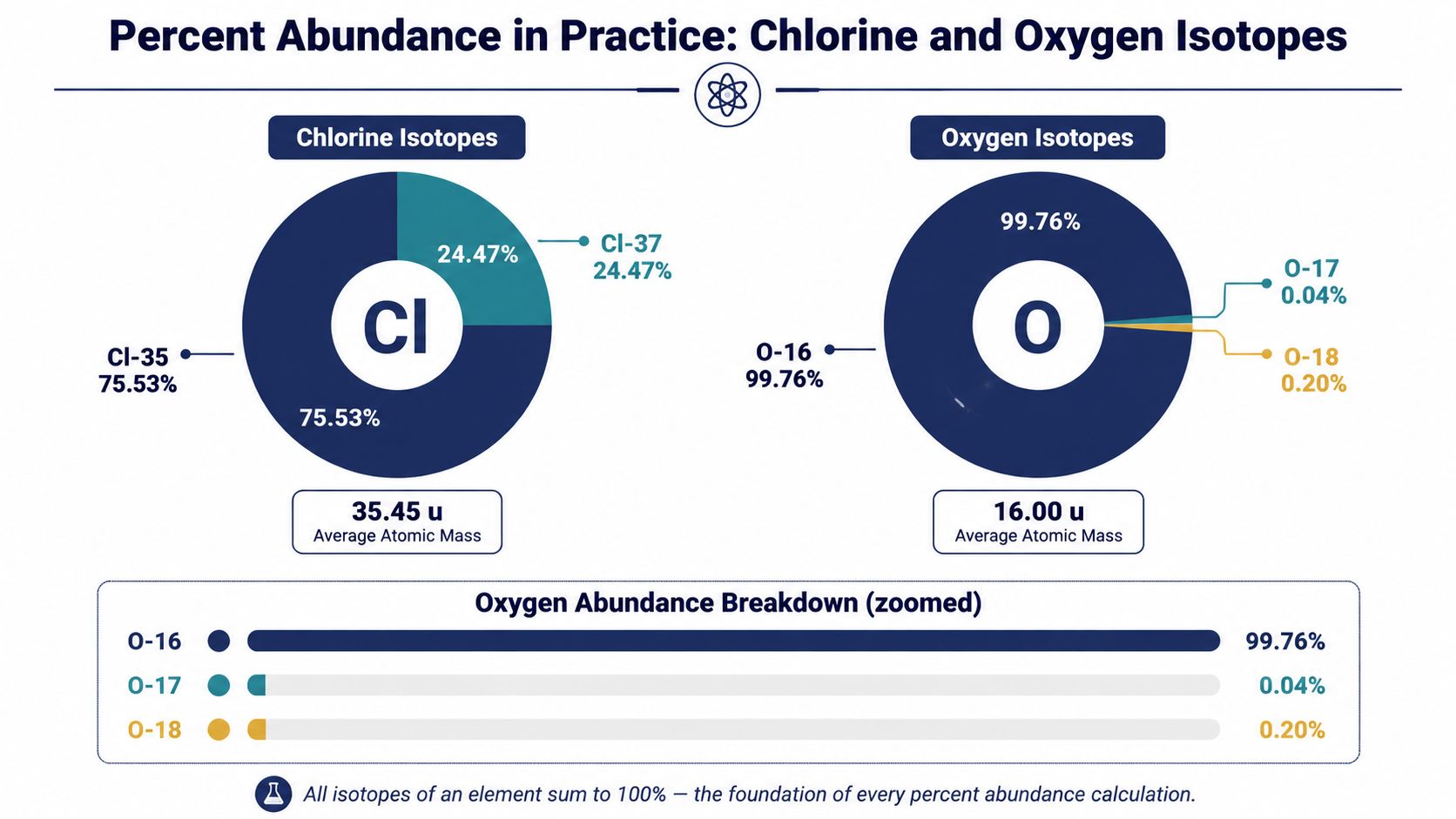
Worked-result check: the final answer should always land between the lightest and heaviest isotope, because a weighted average cannot go outside the range of values being averaged.
Comparing Single Isotope Elements With Multi Isotope Elements
Some elements behave almost like a shortcut because one isotope dominates so strongly that the periodic-table mass barely moves away from that isotope's mass number. Others spread their atoms across several isotopes, so the average shifts more noticeably. That difference matters because it tells you whether a decimal atomic mass is basically a single-isotope story or a true blend.
| Atomic Mass Outcomes for Monoisotopic vs Multi-Isotope Elements | Element | Stable Isotopes | Most Abundant Isotope (%) | Atomic Mass (u) |
|---|---|---|---|---|
| Monoisotopic example | F | 1 | 100 | about 19 |
| Monoisotopic example | Na | 1 | 100 | about 23 |
| Multi-isotope example | Cl | 2 | 75.53 | about 35.45 |
| Multi-isotope example | Cu | 2 | 69.15 | about 63.55 |
| Multi-isotope example | Br | 2 | 50.69 | about 79.90 |
| Multi-isotope example | Ag | 2 | 51.84 | about 107.87 |
| Multi-isotope example | Sn | many | spread across several isotopes | about 118.71 |
The pattern is easier to see than to memorize. When one isotope is overwhelmingly common, the atomic mass sits near that isotope's mass number. When the abundances are spread out, the periodic-table value slides farther from any single whole number because more than one isotope is pulling on the average.
Chlorine is a good bridge between the two extremes. It has two stable isotopes, but one of them is much more common, so the atomic mass still stays fairly close to 35. Br, Ag, and Sn are harder to mentally compress into a single whole number because the mix is less lopsided.
Rule of thumb: don't ask, “How many isotopes does this element have?” Ask, “How uneven is the abundance spread?” That's what really shapes the decimal.
Three Worked Practice Problems With Full Solutions
Problem 1, two isotopes
Gallium has 60.1% Ga-69 and 39.9% Ga-71. What is the average atomic mass?
Use the weighted average.
Average atomic mass = (69 × 0.601) + (71 × 0.399)
Now calculate each part.
69 × 0.601 = 41.469
71 × 0.399 = 28.329
Add them.
41.469 + 28.329 = 69.798 u
So the average atomic mass is 69.80 u when rounded to two decimals.
A common slip here is forgetting to convert the percentages to decimals before multiplying.
Problem 2, three isotopes
Neon has 90.48% Ne-20, 0.27% Ne-21, and 9.25% Ne-22. Find the average atomic mass.
Set up the weighted average.
Average atomic mass = (20 × 0.9048) + (21 × 0.0027) + (22 × 0.0925)
Multiply each term.
20 × 0.9048 = 18.096
21 × 0.0027 = 0.0567
22 × 0.0925 = 2.035
Add them.
18.096 + 0.0567 + 2.035 = 20.1877 u
Rounded to two decimals, the answer is 20.19 u.
The common slip here is dropping the tiny middle isotope because it looks unimportant, even though it still belongs in the sum.
Problem 3, reverse problem
The average atomic mass of chlorine is given as 35.45 u. If Cl-35 is 24.23%? No. That setup is backwards, so let's use the standard form students face. If Cl-35 is 75.77%, what is the abundance of Cl-37?
Because the abundances must sum to 100%, subtract.
100% - 75.77% = 24.23%
So Cl-37 = 24.23%.
If you want to check the weighted-average logic, write it as:
35.45 = (35 × 0.7577) + (37 × x)
Then solve for x. The answer should still come out to about 0.2423, which is 24.23%.
The common slip here is rounding too early and then getting a slightly off final abundance.
Where Percent Abundance Shows Up Beyond the Textbook
Mass spectrometry turns percent abundance into a visible pattern. The instrument ionizes a sample, separates the ions by mass-to-charge ratio, and produces a spectrum with peaks whose heights reflect relative isotopic abundance. The chemistry is the same as the classroom formula, only the numbers are coming from a machine instead of from a worksheet.
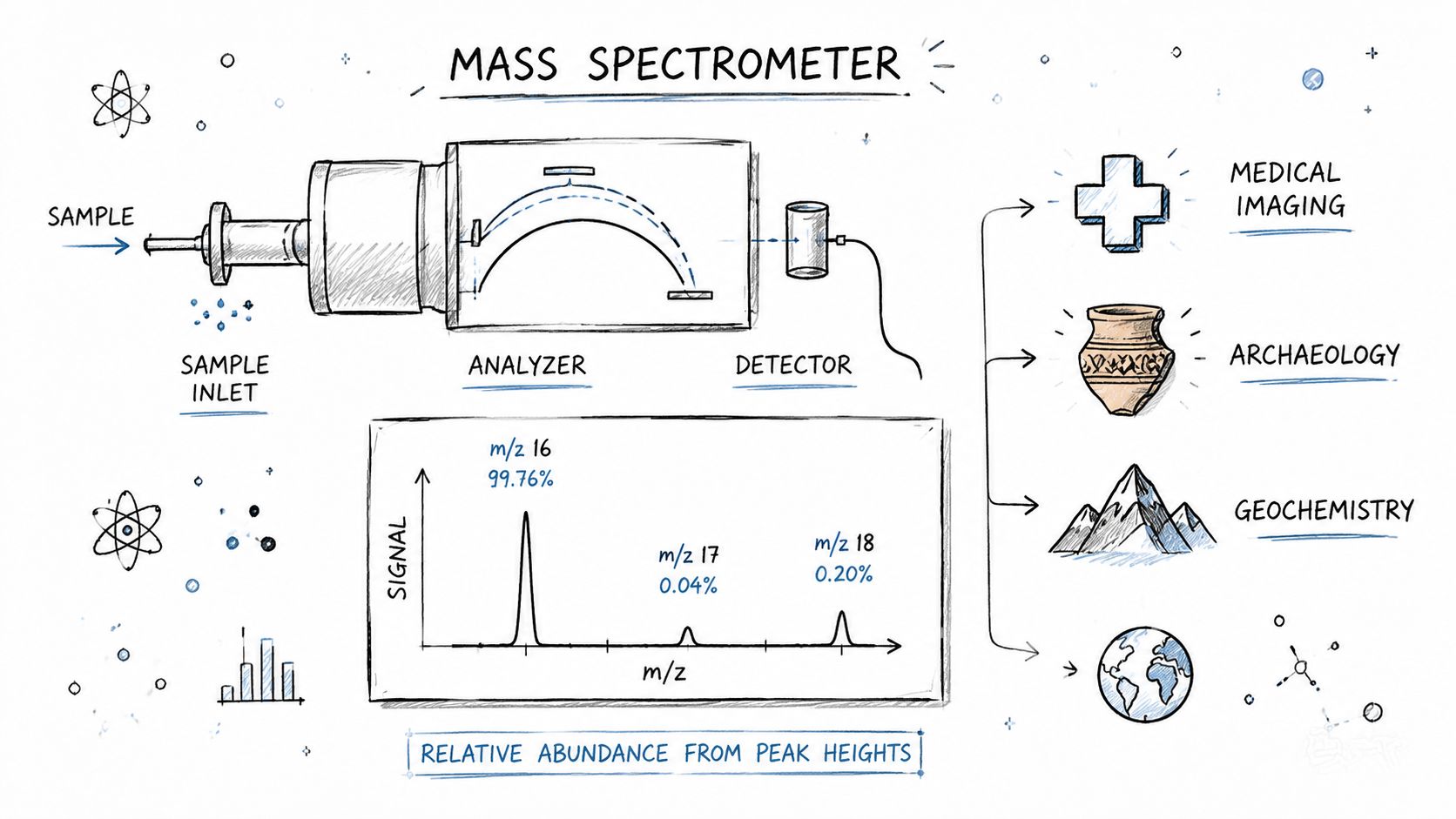
That idea extends to tracing isotopes in real samples. Chemists use isotopic signatures to follow where atoms came from, how they moved, and what changed along the way. The calculation still rests on the same logic you used for oxygen and carbon, because a detector only becomes useful when someone knows how to interpret the isotope mix behind it.
Radiocarbon dating uses the same broad logic too. Living things keep a fixed relationship between carbon-14 and carbon-12, and once an organism dies, the carbon-14 fraction starts to drop. Archaeologists and geochemists use that change as a clock, but the reasoning still depends on abundance, ratio, and decay rather than on a single atom's mass.
The classroom formula is not a separate topic from the lab instrument. It's the translation rule that lets chemists move from a messy sample to a meaningful result.
Common Misconceptions That Trip Students Up
A few small mistakes cause most lost points, and they usually come from mixing up the role of each number.
- Mass number vs. atomic mass: mass number counts protons and neutrons in one atom. Atomic mass gives the weighted average across all naturally occurring isotopes of the element. A chlorine atomic mass of 35.45 u describes the element's isotope mix, while a single chlorine atom still has a whole-number mass number.
- The decimal trap: seeing 35.45 and guessing the isotopes must be 35 and 36. Chlorine's real isotopes are chlorine-35 and chlorine-37, so the average lands between them.
- Skipping the 100% rule: if the abundances do not total 100%, one isotope is missing or the problem was copied wrong.
- Using the percent instead of the decimal: 75.53 must become 0.7553 before multiplying.
- Assuming every element has multiple isotopes: some elements are monoisotopic, which means naturally occurring samples behave as if one isotope dominates because the others are absent or too rare to matter. Examples include beryllium, fluorine, sodium, aluminum, phosphorus, scandium, manganese, cobalt, arsenic, yttrium, niobium, rhodium, indium, iodine, cesium, gold, and bismuth.
A quick self-test catches most errors. If your answer is a decimal atomic mass, check whether you used a mass number by mistake, forgot to convert a percent to a decimal, or left out an isotope. Then redo the setup before trusting the result.
Recap Checklist and One Stretch Problem to Try
Use this as a last check before an exam.
| Step | What to verify |
|---|---|
| 1 | Identify each isotope and its mass. |
| 2 | Make sure the abundances add to 100%. |
| 3 | Convert each percent to a decimal fraction. |
| 4 | Multiply each mass by its decimal abundance. |
| 5 | Add the products. |
| 6 | Keep the result between the lightest and heaviest isotope. |
| 7 | Label the final value in amu. |
One extra detail helps with real problems. If the abundance is given to one decimal place, the final atomic mass should usually be reported with similar care, since extra digits can look more exact than the data allows.
Now try this on your own. An element X has X-84 at 28.0%, X-86 at 51.0%, and X-87 at 21.0%. Compute the average atomic mass, decide which isotope pulls the value most strongly, and explain why the answer cannot be a whole number.
The same weighted-average method you practiced in the previous problems applies here. It does not ask you to memorize isotope names, only to combine each mass with the right share of the sample.